

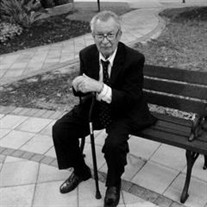
On July 19, 1929, Raymond Witold Szulc was born to Adamina and Kazimierz Szulc, in Warsaw, Poland. He was affectionately known as Rajek, among family and friends.
He had one older brother, Andrzej. His happy childhood was not to last, however, as war came to Poland on September 1st, 1939.
The Szulc family lived in the Polish capital, Warsaw, which was soon occupied by Nazi forces. At the young age of fifteen, Raymond joined the Home Army (Armia Krajowa) which was the dominant resistance movement in German-occupied Poland during World War II. The Home Army’s most widely known operation was the Warsaw Uprising of August-October 1944, in which Raymond took part, defending his city and beloved country from enemy forces. He served as a messenger, delivering reports and carrying medicine, food, ammunition, and weapons, amid active fighting.
After 63 days of fighting, the Uprising failed. The Germans razed the city of Warsaw, indiscriminately killing soldiers and civilians, alike. Raymond survived the slaughter by escaping through the underground sewers.
When the war ended, Raymond joined the Polish Navy and served for two years. He studied to become a radiotelegraph officer, and achieved the rank of bosmanmat (bsmt,) a non-commissioned officer.
After service, he continued working as a radiotelegraph officer on the s/s Praca, a civilian oil tanker. On October 4th, 1953, while in the West Pacific Ocean, 125 nautical miles southeast of Taiwan, Praca was illegally captured and seized by the forces of Chiang Kai-shek. The ship was made to sail into Taiwan, and the crew forced to disembark. The 29 Polish sailors, including Raymond, were transferred to a military detention center in Zouying. Held against their will, the sailors were told they could not return to Poland due to the “imminent outbreak of World War III.” Another Polish ship, the s/s Prezydent Gottwald, was captured several months later, and 33 polish sailors joined their fellows in detention. The seizure of both ships, and the plight of the captured sailors, became a major political incident during the Cold War.
On October 29, 1954, the ordeal ended for 22 sailors, Raymond among them, when the Taiwanese government allowed them to be brought to the United States. The arrival of the freed sailors in New York City became a major press event and stirred heartstrings across the country.
Raymond moved to New Jersey and worked for the Department of Public Works in Harrison, New Jersey. He kept busy, working evenings as a bartender in the local Polish Club.
In his later years, Raymond retired to Orlando, Florida. He was an active member of the Polish Community at St. Joseph’s Catholic Church, serving as Eucharistic Minister.
Rajek, as he was called by everyone, was a beloved and treasured part of the community. He never forgot his motherland. On anniversaries of the Warsaw Uprising, Raymond would wear his uniform to church, accompanying the Polish flag to the altar.
He is best remembered for his kindness to the sick and ill members of the community, whom he would unfailingly visit in the hospital, bringing a card, flowers, and words of comfort.
Raymond was married 4 times, and is survived by his children, daughters-in-law, stepchildren, grandchildren, and great-grandchildren, and his wife.
His loss is greatly felt by all.